How to cut crown molding flat on the saw
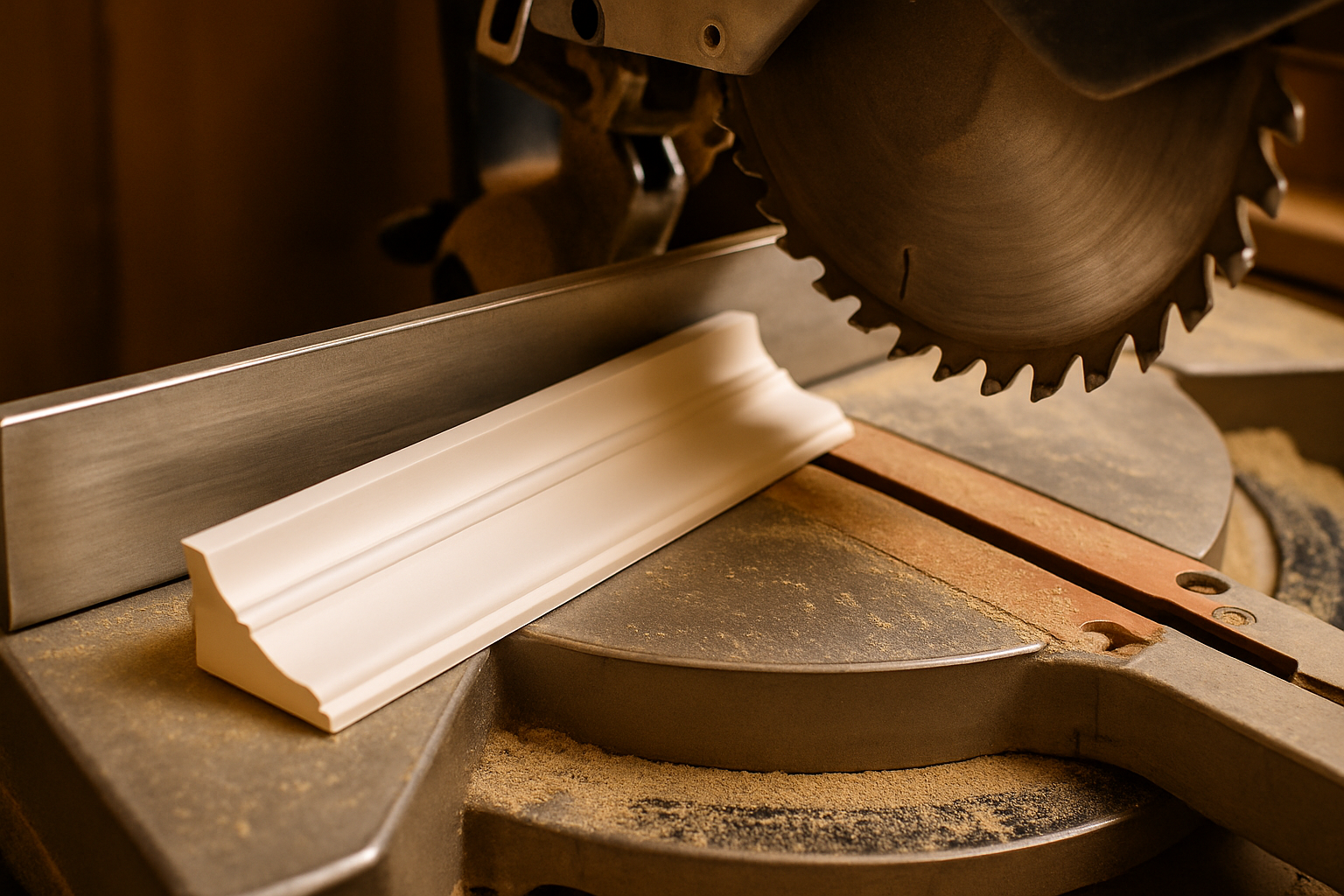
To cut crown molding flat, lay it face up on the saw table with the ceiling edge against the fence, then cut with both a miter and a bevel set on the saw. Cutting flat works on any compound saw, holds long pieces steady, and is the only practical way to deal with corners that are not square. The price you pay is two settings instead of one, and getting the orientation right.
The two ways to cut crown
There are two accepted methods, and the difference is how the molding sits on the saw.
Nested against the fence
In the nested method you stand the molding up against the fence at its spring angle, upside down, the way it would sit between an upside-down wall and ceiling. Because the molding is already tilted to its real angle, you only set the miter. The fence acts as the ceiling and the table acts as the wall. It is fast and uses one setting, but it needs a tall fence to support the molding and it gets unwieldy on long or wide pieces that lean and tip.
Flat on the table
In the flat method the molding lies face up on the table and you cut a compound: a miter on the table plus a bevel on the blade. The saw recreates the spring-angle tilt for you. This is the method this guide focuses on, because it is the more forgiving one.
Why cut flat
Cutting flat earns its place for three reasons. It works on any compound saw, even small ones without much fence height, because the molding never has to stand up. It handles long pieces that would tip over or sag when nested, since the whole length rests on the table. And it is the only practical way to cut odd, out-of-square corners, where you need to dial in custom miter and bevel numbers that no simple nested setup can match. See how to cut crown molding for odd corners for that case. The tradeoff is real but small: you have to set both a miter and a bevel rather than one angle.
Orientation: the part people get wrong
This is where most miscuts come from, so read it slowly. The molding goes face up on the table, the decorative front facing the ceiling. The ceiling edge, the edge that touches the ceiling once the molding is installed, goes against the fence. The wall edge, the one that meets the wall, points toward you at the front of the table. Face up, ceiling edge to the fence, wall edge toward you. Burn that into memory before you cut anything, because a piece cut in the wrong orientation looks fine until you hold it up to the corner.
For the common case, a 90 degree corner with 38 degree spring crown cut flat, the settings are a miter of 31.6 degrees and a bevel of 33.9 degrees. Those happen to fall on standard detents that most compound saws stop at, which is a big part of why 38 degree crown became the default profile.
Source: Family Handyman, How to cut crown molding flat on a miter saw (familyhandyman.com).Step by step
Step 1: know your corner and spring angle
Measure the actual angle the two walls make. A square corner reads 90, but real rooms run a degree or two off in either direction, so measure rather than assume. Then identify your molding's spring angle, the angle the back of the molding makes with the wall. Most crown is 38, 45, or 52 degrees. If you are not sure which you have, read crown molding spring angle explained to find yours.
Step 2: get the miter and bevel from the calculator
Feed the corner angle and the spring angle into the crown molding angle calculator. It returns the exact miter and bevel to set for a flat cut, including the odd-corner numbers you cannot read off a saw detent. This is the step that turns two measurements into two saw settings.
Step 3: set the miter and the bevel
Swing the saw table to the miter angle and lock it. Tilt the blade to the bevel angle and lock that too. Double-check both against the calculator output, since it is easy to read one and forget the other.
Step 4: lay the molding face up, ceiling edge to the fence
Place the molding flat on the table, face up, with the ceiling edge firmly against the fence and the wall edge toward you. Hold it down and back so it cannot creep during the cut. A piece that shifts even slightly will throw the angle off.
Step 5: cut, keeping the correct side
Make the cut, then keep the right piece. Which side you keep, and which way the miter swings, depends on whether the corner is inside or outside and whether the piece is the left or right of the joint. Get the direction sorted before you commit; crown molding inside vs outside corners walks through which side to keep for each.
Step 6: test-fit on scrap first
Cut a short offcut at your settings and hold the two test pieces together in the corner. If the joint closes clean, run the real piece. If it gapes, adjust before you cut anything you care about. A scrap dry-fit costs a minute and saves a length of molding.
Tips that make flat cuts cleaner
A few habits separate a tight joint from a fussy one. Clamp a sacrificial fence and a stop block to the saw so repeat cuts land at the same length and the molding has more to register against. Support long pieces with a roller stand or an outfeed so the weight does not lever the molding away from the fence mid-cut. Mark the keep side with a pencil before you cut, so you never throw away the piece you wanted. And if a finished joint shows a hairline gap, nudge the miter half a degree to close it rather than recutting from scratch.
Sources
- Family Handyman, How to cut crown molding flat on a miter saw and the secret numbers for cutting crown flat (familyhandyman.com).
- Rockler, Crown Molding Cutting Tips (rockler.com).
- Hunker, How To Cut Crown Molding With A Compound Miter Saw (hunker.com).
Frequently asked questions
Should I cut crown molding flat or nested?
Cut flat when you want a method that works on any saw, scales to long pieces that would tip over standing up, and can handle corners that are not 90 degrees. Cut nested, standing the molding against the fence at its spring angle, when you have a tall fence and a tight square corner and want to set only a miter. Flat needs both a miter and a bevel, but it is the more flexible method.
Which edge of crown molding goes against the fence?
When you cut flat, the molding lies face up on the saw table and the ceiling edge goes against the fence. The ceiling edge is the one that touches the ceiling once the molding is installed. The wall edge sits toward you at the front of the table. Getting this orientation right is the part most people miss.
Why does cutting flat need a bevel?
Because the molding is lying flat instead of tilted at its spring angle, the saw has to recreate that tilt itself. The miter angle handles the corner in the horizontal plane, and the bevel tilts the blade to account for the spring angle. Together they make a compound cut that matches what a nested cut does with a single tilted miter.
Can I cut crown flat without a compound saw?
No. Cutting flat requires a saw that bevels, which means a compound miter saw or a sliding compound saw. A plain miter saw that only swings left and right can cut crown nested, standing it against the fence, but it cannot make the bevel a flat cut needs. If your saw does not tilt, cut nested or buy a saw that does both.
What miter and bevel for a 90 degree corner cut flat?
For a standard 90 degree corner with 38 degree spring crown cut flat, set the miter to 31.6 degrees and the bevel to 33.9 degrees. Those are common saw detents, which is why 38 degree crown is so popular. For 45 or 52 degree spring, or any corner that is not 90, run the numbers through the calculator instead of guessing.