How to cut crown molding for odd corners
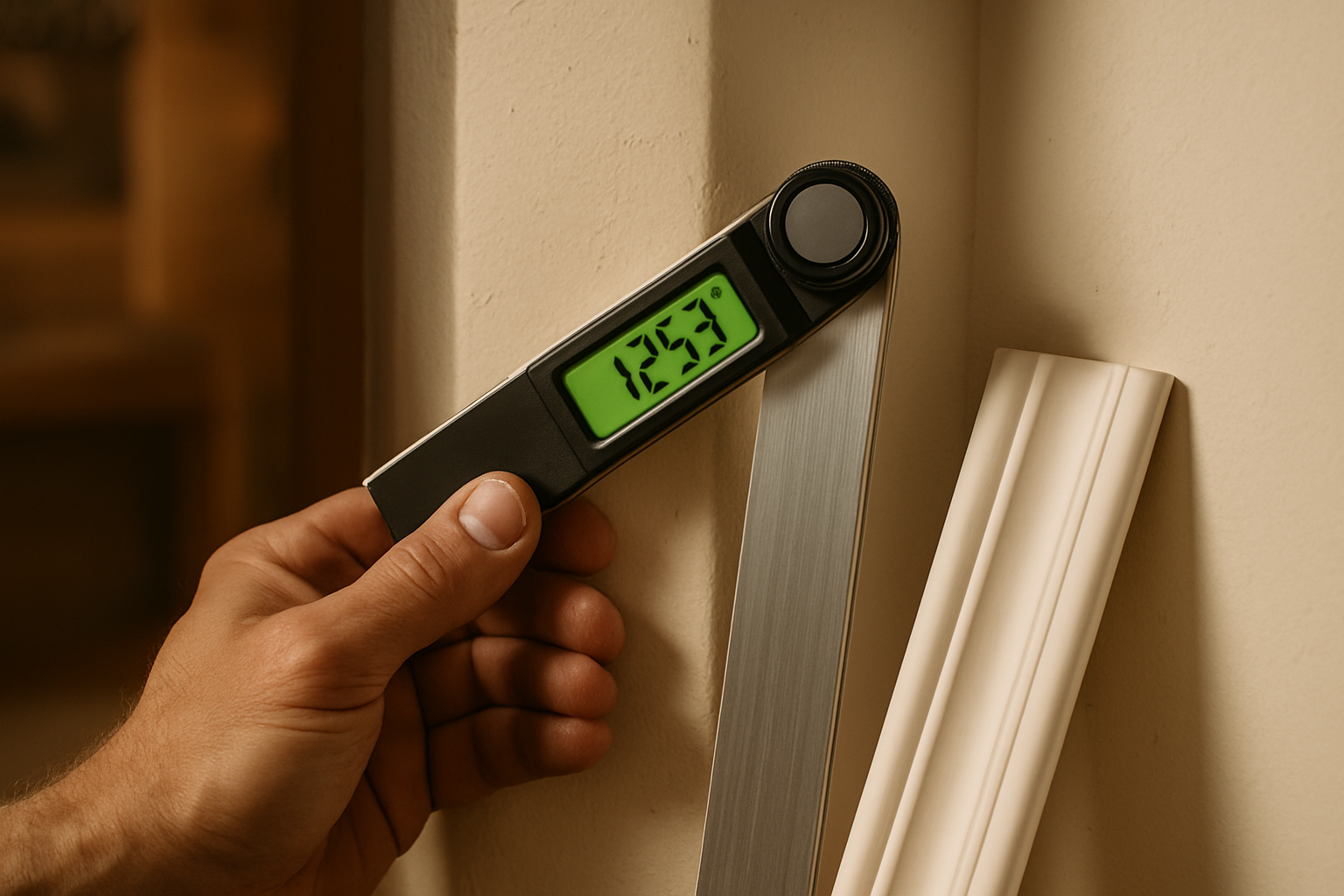
To cut crown molding for an odd corner, stop assuming the corner is 90 degrees and the miter is 45. Measure the real angle the two walls make with a digital angle finder, then feed that corner angle and your molding spring angle into the compound-miter math. That gives you the exact miter (table rotation) and bevel (blade tilt) to cut the piece flat on the saw, so the joint closes tight even on a wall that is out of square.
Why most corners are not square
Drywall, framing, and settling all conspire against the perfect right angle. A corner that should read 90 degrees often comes in at 88 or 93, and you cannot see two or three degrees with your eye, but the saw can. Bay windows are odd by design, usually meeting at about 135 degrees. Stair walls, angled hallways, and vaulted or sloped ceilings add their own angles. The common move, cutting a 45 degree miter and hoping, only ever closes a true 90 degree corner. On anything else it leaves a gap that no amount of caulk fully hides.
On a standard square corner, crown with a 38 degree spring angle is cut flat at a 31.6 degree miter and a 33.9 degree bevel. Those two numbers are the saw detents most miter saws ship with for crown, and they are exact only at 90 degrees. The moment the corner is not square, both numbers move.
Source: Family Handyman, "The secret numbers for cutting crown flat" (familyhandyman.com).The fix: measure the real angle
The whole job comes down to one measurement: the angle between the two walls at the corner. Get that right and the math does the rest. A digital angle finder is the fastest tool, but a protractor or a sliding bevel set against a protractor works just as well. What you are after is the corner angle, not the miter you will cut. The calculator converts one into the other.
How to measure an odd corner
Open the jaws of a digital angle finder and press both arms flat against the two walls, right where they meet, then read the display. If the finder will not reach cleanly into the corner, hold a straight scrap along each wall, let them cross, and measure the angle between the scraps with a protractor. The bisector of that angle is your miter line, but you do not need to do that math by hand. Note the full angle between the walls, for example 92 degrees or 134 degrees, and enter it into the crown molding angle calculator along with your spring angle for the exact miter and bevel.
Why crown needs both a miter and a bevel
Crown is not flat against the wall like baseboard. It springs out at an angle, sitting tilted between the wall and the ceiling, which is exactly what the spring angle describes. Because the molding leans, a single saw cut cannot follow the corner. You need a compound cut: the table rotates (the miter) and the blade tilts (the bevel) at the same time. That is why every crown cut has two numbers, and why changing the corner moves both of them, not just the miter.
The reliable way to make that compound cut is to lay the molding flat on the saw table, face up, with the ceiling edge against the fence, and dial in the miter and bevel from the calculator. This method works on any saw and any corner angle, and the full walkthrough is in how to cut crown molding flat.
Worked examples
These come from the same verified compound-miter formula the calculator uses. They show how the settings shift as the corner and the spring angle change.
A square corner, 38 degree spring
A true 90 degree inside corner with 38 degree spring crown is the standard case: miter 31.6 degrees, bevel 33.9 degrees. These are the saw detent numbers. If every corner in your house were exactly square, you would never touch them.
A bay window, 135 degree corner, 45 degree spring
A typical bay window corner of 135 degrees with 45 degree spring crown comes out to a 16.3 degree miter and a 15.7 degree bevel. The wide, shallow corner pulls both settings far below the square-corner numbers. Try a 45 degree miter here and the gap is obvious. Measure your bay first, though, because not every bay is exactly 135 degrees.
An 88 degree corner, 38 degree spring
Now take a corner that looks square but actually reads 88 degrees, with the same 38 degree spring crown. The settings move to roughly miter 32.5 degrees and bevel 34.5 degrees. That is a small shift from the 90 degree case, but it is the difference between a tight joint and a hairline gap. A two degree wall error is invisible to the eye and very visible at the seam, which is the whole reason to measure rather than assume.
Outside corners and vaulted ceilings
Out-of-square outside corners, like the angled return on a vaulted ceiling or a chimney breast, work the same way. You still measure the angle between the two wall faces, and the magnitude of the miter and bevel is the same as it would be on an inside corner of that angle. What flips is the miter direction and the piece you keep. Get that part wrong and a perfect angle still leaves a gap. The direction rules are spelled out in inside vs outside corners.
Practical tips for a tight joint
Always test-cut on a scrap of the same molding and dry-fit it in the corner before committing to the real piece. If a small gap remains, nudge the miter half a degree and re-cut; a tiny adjustment often closes it. Keep your offcuts labeled so you remember which orientation gave which result. For paint-grade inside corners, coping is a fine alternative that forgives wall error, but mitering with the measured angle is the method that handles outside corners, bay windows, and sloped ceilings too. When in doubt, measure twice and let the calculator carry the trigonometry.
Sources
- Family Handyman, "The secret numbers for cutting crown flat" (familyhandyman.com): the 38 spring, 90 corner figures of 31.6 miter and 33.9 bevel.
- Rockler, "Crown Molding Cutting Tips" (rockler.com): cutting flat, face up, ceiling edge to the fence.
- This Old House and Fine Homebuilding, general crown molding guidance on measuring out-of-square corners.
- blocklayer.com crown molding compound-miter calculator: the corner-angle plus spring-angle method.
Frequently asked questions
How do I measure an odd corner for crown molding?
Hold a digital angle finder or a sliding bevel flat against both walls, right in the corner, and read the angle between the two wall faces. If you do not have an angle finder, lay a scrap along each wall, mark where they cross, and measure that angle with a protractor. The number you want is the angle between the walls, not the miter. Feed that, plus your molding spring angle, into the calculator.
What miter and bevel do I set for a 135 degree bay window corner?
For a 135 degree corner with 45 degree spring crown, the settings come out to about a 16.3 degree miter and a 15.7 degree bevel, cut flat with the molding face up. Always confirm against your own measured angle, because bay windows are not always exactly 135 degrees, and test the setting on a scrap before you cut the real piece.
Why does a 45 degree miter not work on these corners?
A 45 degree miter only closes a 90 degree corner, and even then only when the bevel is set correctly for the spring angle. The instant the wall angle drifts to 88 or 93 degrees, or jumps to 135 at a bay, the two cuts no longer add up to the corner and you get a visible gap. The miter has to be derived from the real angle, not assumed.
Do odd corners change the bevel too, or just the miter?
Both. Because crown sits tilted between the wall and the ceiling, every cut is a compound cut with a table rotation (miter) and a blade tilt (bevel). Changing the corner angle shifts both numbers. A 90 degree 38 spring corner is about 31.6 miter and 33.9 bevel; an 88 degree corner with the same crown moves to roughly 32.5 and 34.5. Small wall errors move both settings.
Can I just cope odd corners instead of mitering them?
Coping is an option for inside corners, especially on paint-grade work, and it hides small wall errors well. But coping only works on inside corners, not outside ones, and it is slower. Mitering with the correct measured angle works on both inside and outside corners and on any angle, including bay windows and vaulted ceilings, which is why it is the more general method.