How to cut crown molding inside corners vs outside
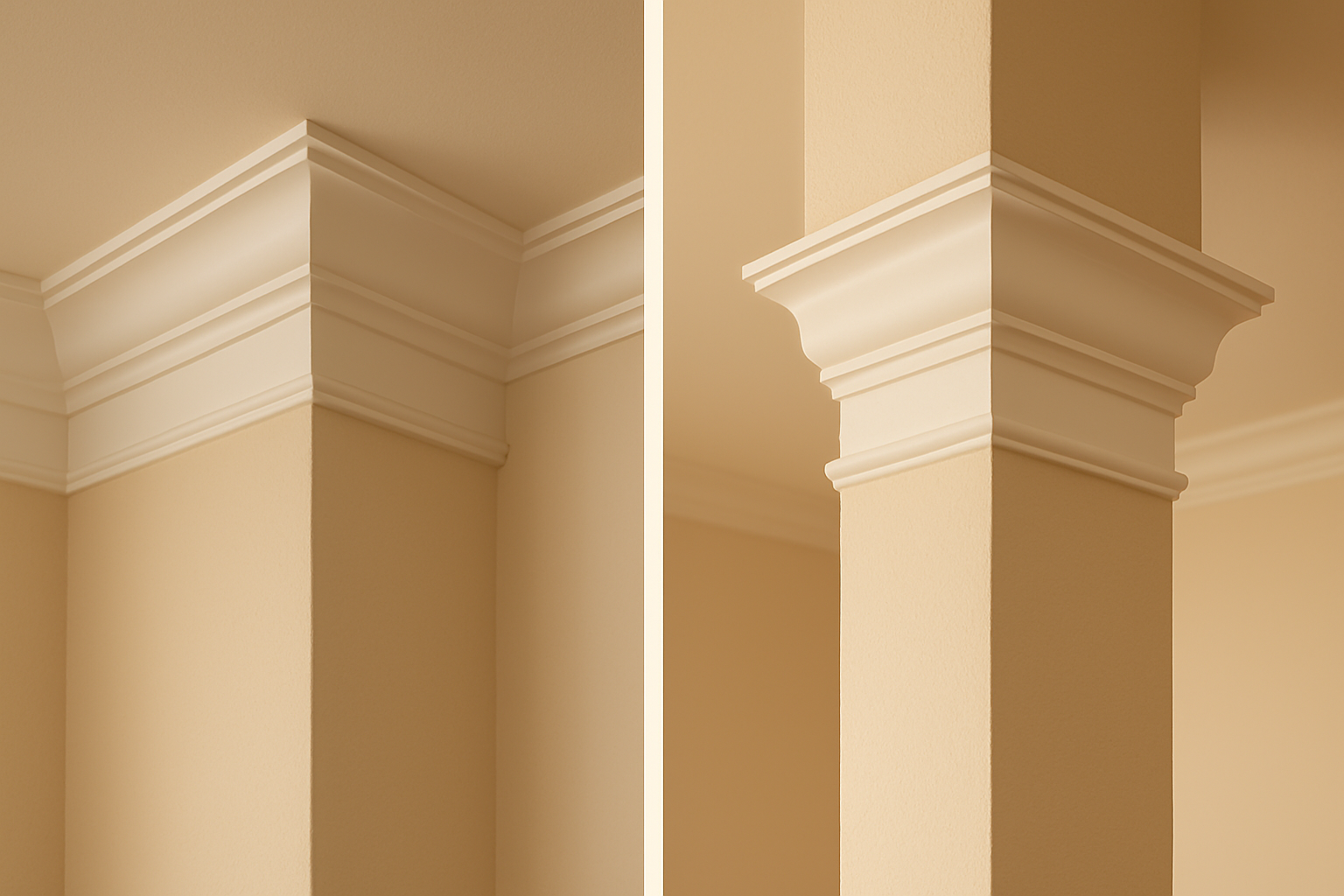
To cut a crown molding inside corner flat on the saw, lay the molding face up with the ceiling edge against the fence, set the miter and bevel for your spring angle, and swing the table away from the piece. For 38 degree crown on a square corner that is a 31.6 degree miter and a 33.9 degree bevel, the same pair DeWalt prints in its saw manuals as 31.62 and 33.85. An outside corner uses the identical numbers with the table swung the other way. The angles never change between the two. What changes is the direction of the swing, which edge of the crown ends up as the long point, and whether you get to cope the joint instead of mitering it.
What angle do you cut crown molding inside corners?
For a square 90 degree corner, cut 38 degree spring crown flat at a 31.6 degree miter and a 33.9 degree bevel. A 45 degree spring crown takes 35.3 and 30. A 52 degree spring crown takes 38.2 and 25.8. The corner is split between the two pieces, so both get the same settings, and an outside corner uses the same row.
| Spring angle | Miter | Bevel |
|---|---|---|
| 38 | 31.6 | 33.9 |
| 45 | 35.3 | 30.0 |
| 52 | 38.2 | 25.8 |
Those rows assume a corner that is a true 90. Most are not. Gary Katz, writing on THISisCarpentry, puts it in inches: a corner 2 degrees out of square drifts 5 inches over a 12 foot wall. A coped joint closes on that corner anyway. A miter does not. With 38 degree crown, an 88 degree corner moves the settings to 32.5 and 34.5, and a 92 degree corner moves them to 30.7 and 33.2, so a 2 degree wall error is close to a degree on the miter and a bit over half a degree on the bevel. Measure the corner, check the profile in crown molding spring angle if you're not sure which crown you have, and run both numbers through the crown molding angle calculator for the exact pair.
DeWalt's miter saw manuals give 31.62 degrees on the miter scale and 33.85 on the bevel for standard US 52/38 crown cut flat on a square corner, and tell you to test every setting on scrap first because room corners rarely come in at 90. That is why most of its saws carry a positive stop at 33.9 on the bevel scale.
Source: DeWalt compound miter saw instruction manual, Cutting crown molding (dewalt.com).Inside and outside corners, defined
An inside corner is the one you meet most. Two walls fold toward you and the molding tucks into the angle between them, like the corner of any ordinary room. The crown lives in the concave nook where wall meets wall meets ceiling.
An outside corner is the opposite. The walls fold away from you around something that sticks into the room: a boxed column, a chimney breast, a kitchen island soffit, or the return at the end of a partition wall. The molding has to wrap around the convex point, and both pieces meet on the face everyone can see.
That visibility is the practical difference. An inside corner that is a little off opens a gap that faces into the nook, half hidden. An outside corner that is off opens a gap that points straight out into the room at eye level, where a guest spots it before the coffee is poured.
Which edge is the long point?
Every crown miter has a long point and a short point, and knowing where each one lands tells you whether a cut is right before the piece goes anywhere near the wall. On an inside corner the wall edge is the long point. The bottom of the crown runs along the wall all the way into the corner, while the top edge runs along the ceiling a few inches out from the wall and meets its partner short of the corner. So the wall edge reaches and the ceiling edge stops early.
On an outside corner it flips. The top edge has to travel around the point, so the ceiling edge is the long point and the wall edge is short. Clayton DeKorne, writing on crown fundamentals for Fine Homebuilding, marks outside miters on the upper edge for exactly that reason.
Use it as the check. Hold a cut piece up in its corner and see which edge reaches the corner. If the wrong one does, the miter was swung the wrong way, no matter how well you set 31.6.
The four cuts, flat on the saw
These rules assume the flat method: molding face up on the saw table, ceiling edge of the profile against the fence. If that orientation is new to you, walk through how to cut crown molding flat first, because everything below depends on the crown sitting that way every time.
Lay each piece the way it hangs, seen from the room. The piece from the left wall lies with its stock running off to your left and its corner end at the blade. The piece from the right wall runs off to your right. You keep the side the piece is on, every time. The only thing that changes between an inside cut and an outside cut is which way the table swings.
Inside corner
Left piece: stock runs off to your left, swing the miter to the right, keep the left of the cut. Right piece: stock runs off to your right, swing the miter to the left, keep the right of the cut. In both cases the table swings away from the piece, and the long point lands on the wall edge, at the front of the table where you can see it.
Outside corner
Left piece: stock runs off to your left, swing the miter to the left, keep the left of the cut. Right piece: stock runs off to your right, swing the miter to the right, keep the right of the cut. Now the table swings toward the piece, and the long point lands on the ceiling edge, back against the fence.
So the whole system is three lines. Inside swings away. Outside swings toward. The keeper never crosses the blade. If you blank at the saw, cut a 12 inch scrap at your settings and hold it up in the corner before you commit a full length. It costs a minute and it saves a 16 foot stick.
Why your saw manual's table looks different
DeWalt's chart lists the same four cuts, but two of its rows put the bottom of the molding against the fence instead of the top. That is not a different geometry. The manual flips the piece end for end on the right inside cut and the left outside cut so it can print one instruction for both inside pieces (save the left end of the cut) and one for both outside pieces (save the right end). With the ceiling edge always on the fence, the way the guides here do it, the kept side follows the piece and the swing follows the corner. Either system works. Mixing them is how a perfect 31.6 ends up with the long point on the wrong edge.
Should you cope inside corners or miter them?
Cope them when the profile and the material allow it. A coped inside corner stays closed as the wood moves with the seasons, sits tight on a corner that is out of square, and can be cut a hair long and sprung into place. A mitered inside corner does none of that. Outside corners are always mitered, because there is no profile to cope against.
Tucker Windover made the case in Fine Homebuilding issue 209. Mitered inside corners open at the short point or the long point as trim shrinks and swells, while a coped joint stays tight because both pieces move together. A cope also forgives a length error of up to 1/8 inch, where a miter shows every sixteenth. His two habits: cut pieces over 8 feet about 1/8 inch long and bow them in, and don't nail within 2 feet of either end until the joint fits. Katz adds that production crews cope every inside corner because it's tighter and, once you have the rhythm, faster. A cope will still close when the ceiling is out, and the cope cut goes as deep as the crown is thick, so 3/4 inch crown gets a 3/4 inch deep cope.
The method piggybacks on the inside cut above. Run the first piece square into the corner and nail it. Cut the second piece at the inside-corner settings, which exposes the profile along the face. Pencil that front edge so it stands out, then follow the line with a coping saw, tilting the blade past square so only the profile line touches. Joseph Truini at This Old House uses about a 5 degree back bevel. Test the fit on a scrap of the first piece, rasp the high spots, and hang it.
Coping has limits. MDF crown crumbles at the thin edges, so Windover miters it. Some profiles have returns that no saw can follow, and Katz miters those, along with cabinet crown on boxes you already know are square and the small pre-assembled pieces on columns and mantels. Everything else gets coped.
How do you measure and cut an outside corner?
Trace the top edge of a crown scrap onto the ceiling along both walls. Where the two pencil lines cross is the long point of each miter, so measure to it and cut at the outside-corner settings with the table swung toward the piece. Glue the joint, pin it, and expect the corner to read past 90.
That crossing-lines method is DeKorne's, and it beats measuring the short point at the wall because the ceiling line is where the joint shows. The corner itself is rarely a clean 90 either. Corner bead under the drywall mud pushes an outside corner outward, so it tends to read 91 or 92 and the miter may need a swipe with a block plane on the back to close. Measure it with an angle finder instead of trusting the framing. Bosch rates its GAM 220 MF to 0.1 degree, which is finer than any saw scale. A corner that reads 92 with 38 degree crown wants 30.7 and 33.2 rather than the detent values. Cut a touch long, dry-fit, and trim to a tight joint. For corners further from square, how to cut crown molding for odd corners covers the measuring.
Assemble the corner before it goes up if you can. Katz glues outside corners on the bench with Titebond, which gives him time to align the profiles before it grabs, then hangs the assembly as one piece. Truini glues the miter, drills two pilot holes through the point, and drives finish nails through them, with a nail top and bottom on each leg. A 23 gauge pinner does the same job without splitting the tip. Either way the glue is what holds the point closed; the fasteners hold it still while the glue sets.
Mark, dry-fit, and read the gap
One habit prevents most ruined pieces: mark the room-facing side of every piece before you cut, so you always know which face is the keeper and which way is up. Then dry-fit the joint before any nail goes in. A gap you can see dry is a gap you can fix. A gap you nail in place is a gap you caulk and live with.
Measuring is where outside corners trip people up. Inside pieces run to the wall and stop. Outside pieces run past the corner, because the molding has to wrap around the point before the miter begins, so the piece is longer than its wall.
The gap tells you which way to adjust. If the joint touches at the long point and opens at the short point, the corner is tighter than you cut for, so raise both settings. If it opens at the long point, the corner is wider, so drop them. On 38 degree crown, each degree of wall is worth about half a degree on the miter and a third of a degree on the bevel, which is why a scrap test beats guessing. Nailing, layout, and the order to work around the room are in how to install crown molding.
Sources
- DeWalt, compound miter saw instruction manual, Cutting crown molding (dewalt.com, manualslib.com): the 31.62 degree miter and 33.85 degree bevel, the four-row inside and outside table, and the scrap-test advice.
- Family Handyman, The secret numbers for cutting crown flat (familyhandyman.com): 31.6 and 33.9 on 38 degree spring crown.
- Gary Katz, Cutting and Coping Crown Molding, THISisCarpentry, 2019 (thisiscarpentry.com): 2 degrees over 12 feet being 5 inches, cope depth equal to crown thickness, and why production crews cope.
- Gary Katz, Installing Crown Molding, THISisCarpentry, 2015 (thisiscarpentry.com): pre-assembled glued outside corners and the profiles that have to be mitered.
- Tucker Windover, Inside Crown Corners, Fine Homebuilding issue 209, January 2010 (finehomebuilding.com): wood movement, the 1/8 inch forgiveness, the 2 foot no-nail zone, and when not to cope.
- Clayton DeKorne, Crown-Molding Fundamentals, Fine Homebuilding issue 152 (finehomebuilding.com): marking the outside long point on the ceiling and corner bead pushing corners outward.
- Joseph Truini, How To Install Crown Molding, This Old House (thisoldhouse.com): gluing and nailing outside miters and the 5 degree back bevel.
- Bosch, GAM 220 MF specifications (boschtools.com): the 0.1 degree accuracy. Off-square settings computed with the same formulas as the CrownMiter calculator.
Frequently asked questions
What angle do you cut crown molding inside corners?
For a square corner, 38 degree spring crown cut flat takes a 31.6 degree miter and a 33.9 degree bevel, 45 degree crown takes 35.3 and 30, and 52 degree crown takes 38.2 and 25.8. Both pieces get the same settings. If the corner reads 88 or 92 instead of 90, the settings shift about a degree, so measure it first.
Which way do you swing the miter for an inside corner?
Away from the piece. With the molding face up and the ceiling edge on the fence, the piece from the left wall runs off to your left, so swing the miter right and keep the left of the cut. The piece from the right wall runs off right, so swing left and keep the right. The long point should land on the wall edge.
Are the saw angles different for inside vs outside corners?
No. For any corner angle and spring angle, the miter and bevel are the same size for both. What changes is the swing: away from the piece for an inside corner, toward it for an outside corner. The keeper stays on the same side of the blade. The two cuts are mirror images of each other.
Can I cope an outside corner?
No. Coping only works on inside corners, where one piece is cut square and the other is shaped to nest over its profile. Outside corners have no profile to ride against, so they are always mitered, glued at the joint, and pinned while the glue sets.
How do I measure an outside corner?
Trace the top edge of a crown scrap on the ceiling along both walls. The point where the lines cross is the long point of each miter, so measure to it. Check the corner with an angle finder, since corner bead often pushes it past 90, and cut a little long so you can trim to a tight fit.