Crown molding spring angle explained
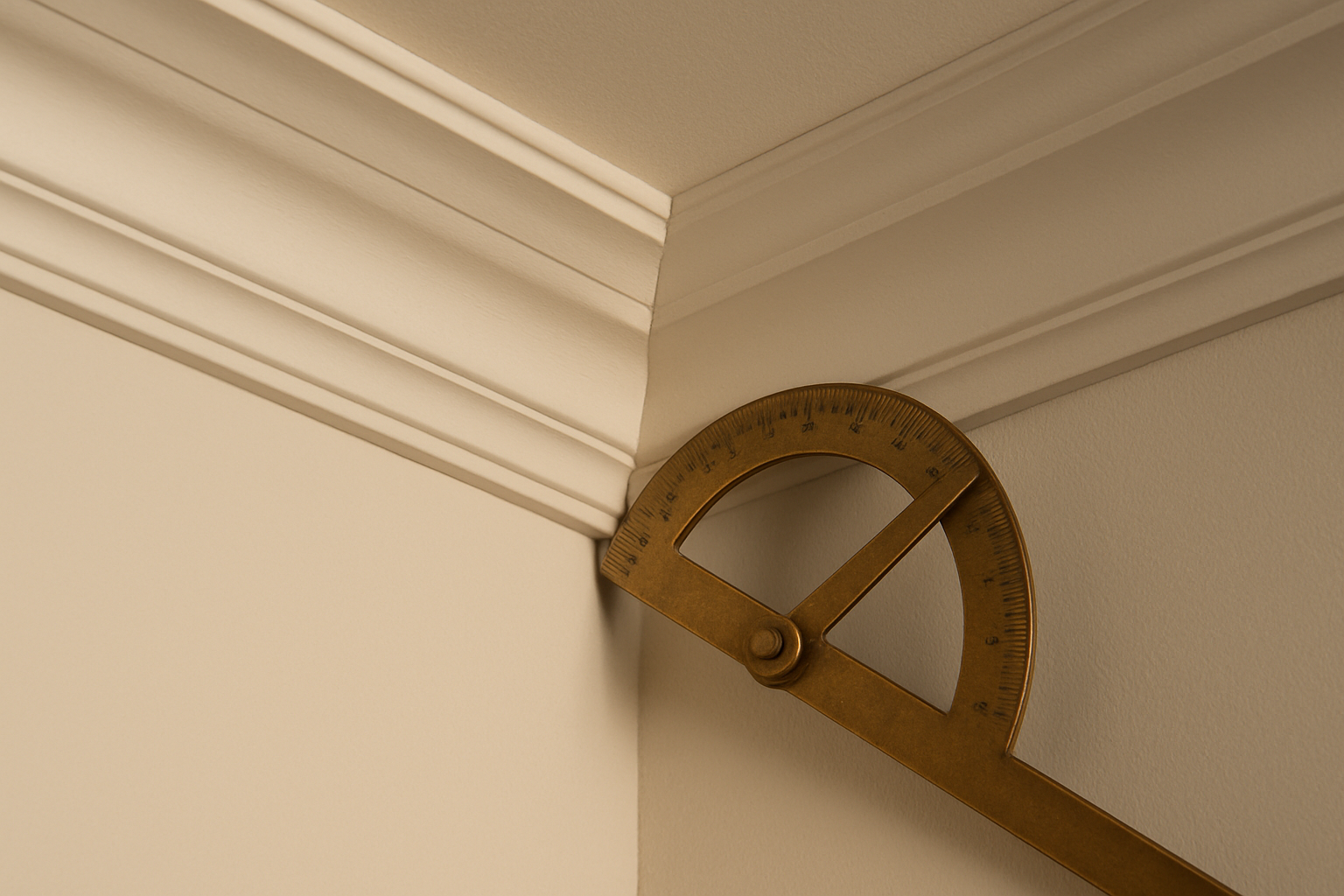
The spring angle is the angle the back of the molding makes with the wall once it is installed, or how far the molding springs off the wall toward the room. It is fixed by the molding profile, and it changes the saw settings as much as the corner does. The three common profiles are 38, 45, and 52 degrees, and each one cuts a square corner at a different miter and bevel.
What the spring angle is
Crown molding does not lie flat against the wall or flat against the ceiling. It tilts, bridging the gap between the two and projecting out into the room. The spring angle measures that tilt: it is the angle between the back face of the molding and the wall. A small spring angle keeps the molding close to the wall and standing tall, while a larger one lays the molding back toward the ceiling and projects it further into the room. Because the angle is built into the profile, you cannot change it on site. It is whatever the molding was milled to be, and your job is to find that number and cut to it.
The three common profiles: 38, 45, and 52
Almost all US crown molding ships as one of three spring angles. The 38 degree profile is by far the most common, the one most stock molding at the home center will be. The 45 degree profile sits symmetrically between wall and ceiling. The 52 degree profile lays back further and reads more like a cornice. Knowing which of the three you have is the single most important fact before you make a cut, because the saw settings change with each one.
Reading the "52/38" name
Crown is often sold with a two-number name like 52/38, and this confuses a lot of people. The two numbers are the angles the molding makes with the ceiling and the wall, in that order. A 52/38 crown sits 52 degrees off the ceiling and 38 degrees off the wall. The spring angle is the wall number, so a 52/38 crown has a 38 degree spring angle. The pair always adds up to 90, because the wall and ceiling meet at a right angle, so 52/38 and 38/52 are simply the two ends of the same relationship. When someone says 38 crown, 52/38 crown, and 38 degree spring angle, they all mean the same molding. A 45/45 crown is symmetric, with a 45 degree spring angle, and a 38/52 crown has a 52 degree spring angle.
Why the spring angle changes the cut
It is tempting to think the corner angle is the only thing that drives the saw settings, but the spring angle matters just as much. Because the molding is tilted in space, cutting a clean corner is a compound problem: you are slicing through a board that is leaning two ways at once. Change how far it leans off the wall and you change the geometry of the cut, even if the corner stays a perfect 90 degrees. That is why the same square corner needs different miter and bevel numbers for each profile. Get the spring angle wrong and a corner you measured perfectly still opens up a gap.
For a square 90 degree corner, a 38 degree spring crown cuts at a 31.6 degree miter and a 33.9 degree bevel. The 38 degree profile is so standard that many compound miter saws have detents stamped right at those two numbers, so you can drop the saw onto the marks without dialing.
Source: Family Handyman, "The secret numbers for cutting crown flat" (familyhandyman.com).The saw settings for a square corner, by spring angle
For a standard inside or outside corner of 90 degrees, cutting the molding flat on the table, the settings change with the profile:
- 38 degree spring: miter 31.6 degrees, bevel 33.9 degrees.
- 45 degree spring: miter 35.3 degrees, bevel 30.0 degrees.
- 52 degree spring: miter 38.2 degrees, bevel 25.8 degrees.
These are the flat-cut numbers, with the molding face up on the saw table rather than nested against the fence. If your corner is not a clean 90 degrees, the numbers shift again, and that is where the math gets fiddly to do by hand. Enter your spring angle and your real corner angle into the crown molding angle calculator and it returns the exact miter and bevel for that combination. To cut to those numbers, see how to cut crown molding flat on the saw.
How to find your spring angle
Start with the obvious: the spring angle is often printed on the molding itself or on the box it came in, so check there first. If nothing is marked, you can measure it. Set a length of molding against a framing square so the ceiling edge rests on one leg and the wall edge on the other, then read the angle the back of the molding makes with the wall leg. That number is your spring angle. You can also nest the molding into an actual wall-and-ceiling corner the way it will sit when installed and measure how it lands. When you genuinely cannot tell, remember there are only three usual answers, 38, 45, and 52 degrees, so cut a test joint on scrap at each one and keep the setting that closes tight.
The detent shortcut for 38 degree crown
Because 38 degree spring is the default profile, saw makers built around it. Many compound miter saws have positive detents at exactly 31.6 degrees on the miter scale and 33.9 degrees on the bevel scale, the precise settings a 38 degree crown needs for a square corner. If your molding is the common 38 degree profile and your corner is close to 90 degrees, you can often snap the saw to those detents and cut without doing any math. For anything else, an odd corner or a 45 or 52 degree profile, you need the actual numbers, which is exactly what the calculator is for.
Spring angle and the rest of the job
The spring angle is one of two inputs to every crown cut. The other is the corner. Once you know your profile, the work is figuring out the real angle each corner makes and feeding both numbers into the math. Walls are rarely perfectly square, so read how to cut crown molding for odd corners to measure the true angle, and read inside vs outside corners to get the miter direction right. With the spring angle pinned down and the corner measured, every cut becomes a known number rather than a guess.
Sources
- Family Handyman, "The secret numbers for cutting crown flat": 38 degree spring at a 90 degree corner cuts 31.6 miter and 33.9 bevel, with saw detents at those points (familyhandyman.com).
- Rockler, "Crown Molding Cutting Tips": spring angle, nesting the molding against the fence, and reading the profile (rockler.com).
- blocklayer.com crown molding calculator: spring angle definition and the compound-miter method for any corner (blocklayer.com).
Frequently asked questions
What is the spring angle on crown molding?
The spring angle is the angle the back of the molding makes with the wall once it is installed. It tells you how far the molding springs off the wall toward the room as it bridges the gap to the ceiling. The angle is fixed by the molding profile, so every length of the same molding has the same spring angle.
What does 52/38 crown mean?
The two numbers are the angles the molding makes with the ceiling and the wall. A 52/38 crown sits 52 degrees off the ceiling and 38 degrees off the wall, so its spring angle is 38 degrees. The 38 is the number you feed into the saw math. The pair always adds to 90, because the wall and ceiling meet at a right angle.
How do I find my crown molding's spring angle?
Check the molding or its box, since the spring angle is often printed on it. If it is not, set a piece against a framing square and measure the angle the back makes with the wall leg, or nest the molding in a corner and measure how it sits. When you still cannot tell, the three common values are 38, 45, and 52 degrees, so test a cut on a scrap and see which one closes the joint.
What is the most common crown molding spring angle?
A 38 degree spring angle is the most common in the United States, sold as 52/38 crown. It is so standard that many compound miter saws have detents stamped at 31.6 degrees miter and 33.9 degrees bevel, the exact settings a 38 degree crown needs for a square 90 degree corner.
Does the spring angle change the saw settings?
Yes, and by a lot. The same 90 degree corner needs a different miter and bevel for each spring angle. A 38 degree crown cuts at 31.6 miter and 33.9 bevel, a 45 degree crown at 35.3 and 30.0, and a 52 degree crown at 38.2 and 25.8. Use the wrong spring angle and a perfectly measured corner still leaves a gap.