How to cut crown molding corners
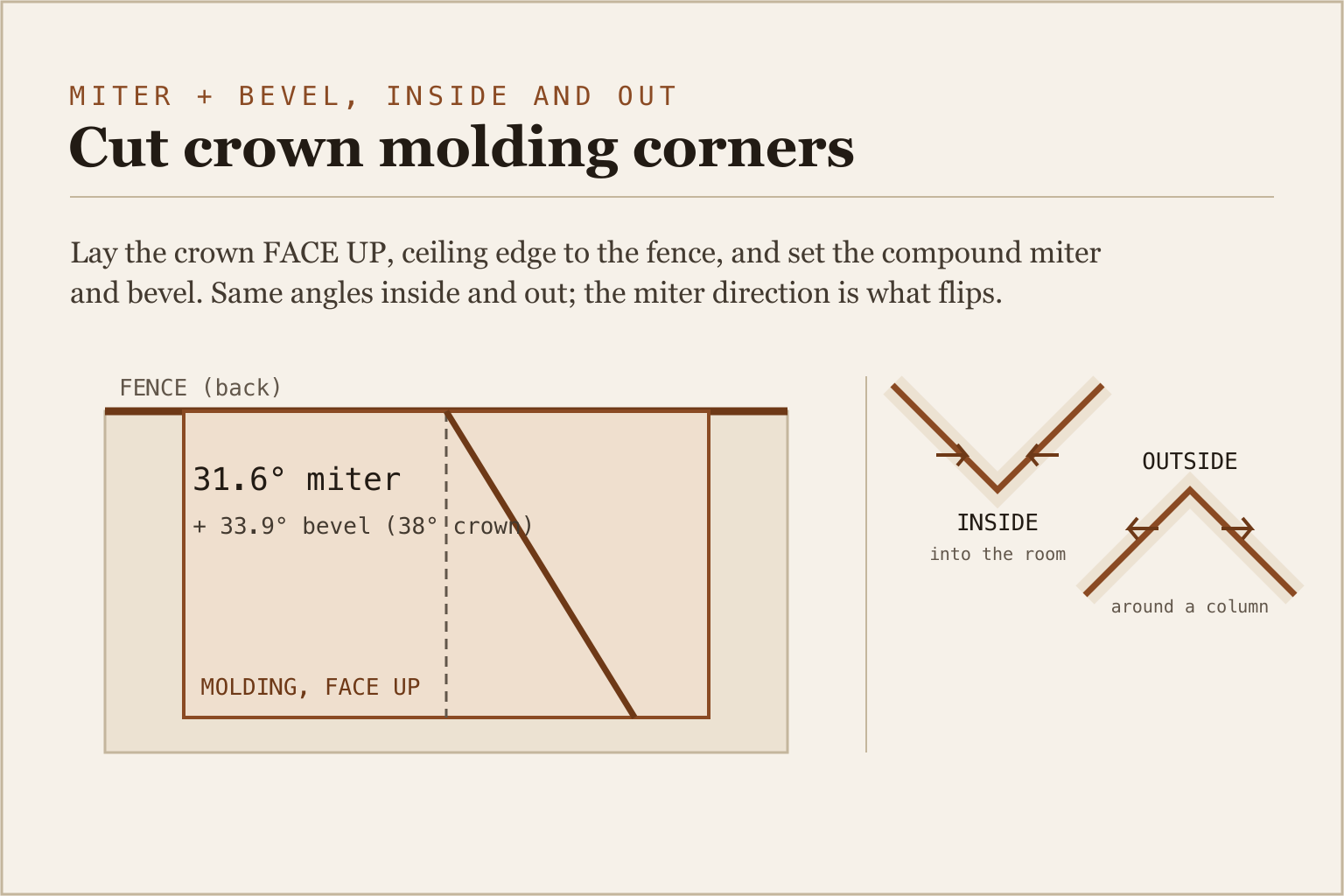
Every crown corner comes down to two numbers. The angle the two walls make, and the spring angle of the molding itself. Once you have both, the saw settings are fixed, and a corner that looked like guesswork becomes a repeatable cut. For the most common setup, a square 90 degree corner with a 38 degree spring crown laid flat on the saw, the numbers are a 31.6 degree miter and a 33.9 degree bevel. Dial those in, mind which way the joint turns, and the two pieces close tight. Here is the whole process, inside corners and outside corners, from the first measurement to the last dry-fit.
What angle do you cut crown molding corners?
For a square 90 degree corner you cut a compound angle, not a plain 45. With a 38 degree spring crown laid flat and face up on the saw, that is a 31.6 degree miter and a 33.9 degree bevel. The spring angle sets those numbers, so a 45 or 52 degree profile needs different ones.
Here are the settings for a square 90 degree corner, cutting the crown flat on the table with the ceiling edge against the fence:
- 38 degree spring: miter 31.6 degrees, bevel 33.9 degrees.
- 45 degree spring: miter 35.3 degrees, bevel 30.0 degrees.
- 52 degree spring: miter 38.2 degrees, bevel 25.8 degrees.
Those are the magic numbers carpenters memorize, and most compound miter saws carry hard click-stops at the 38 degree row because that profile is so common. Drop the saw onto the 31.6 and 33.9 marks and cut without dialing.
Source: Family Handyman, "The secret numbers for cutting crown flat" (familyhandyman.com).The values come straight from the compound-miter geometry for a flat cut, the same math the Family Handyman crown guide uses. If your crown is a different spring angle, or your corner is not a clean 90, you need your own pair of numbers. Run the real corner and spring angle through the crown molding angle calculator and it gives you the exact miter and bevel to set.
Start with your two numbers
Before you touch the saw, measure the corner and pin down the spring angle. Skip either and you are back to guessing.
The corner angle is what the two walls actually make, not what you assume. Most rooms read 88 or 92 where you expected 90, so hold an angle finder or a bevel gauge into the corner and read it. A couple of degrees off is enough to open a visible gap on a long wall.
The spring angle is baked into the molding. It is the angle the flat back of the crown makes with the wall once it is up, and it is almost always 38, 45, or 52 degrees. Stand a scrap in the corner the way it will hang, or measure the two flats on the back, to tell which one you have. If you are unsure how to read it, the guide on crown molding spring angle walks through it. These two numbers, corner and spring, decide every cut on the wall.
How do you cut an inside corner?
An inside corner is the common one, where two walls fold toward you into the room. Lay the crown flat and face up, set the miter and bevel for your spring angle, and cut each piece as a mirror of the other. The left piece keeps the right of the cut, the right piece keeps the left.
Work through it slowly the first time. Put the molding on the saw face up, with the edge that will touch the ceiling held against the fence. Set the miter and bevel from your numbers, for a 38 degree crown that is 31.6 and 33.9. For the piece running in from the left wall, swing the miter right and keep the piece to the right of the blade. For the piece from the right wall, swing the miter left and keep the left side. The two keepers meet in the nook and the joint closes inward, half hidden from the room. If cutting flat is new to you, read how to cut crown molding flat first, because every setting here assumes that orientation.
How do you cut an outside corner?
An outside corner wraps around something that sticks into the room, like a boxed column or a chimney breast. The angles are the same size as an inside corner, but the direction flips. The left piece keeps the left of the cut, the right piece keeps the right, and both pieces run long so they wrap past the corner point.
So mirror the inside cut. Same 31.6 degree miter and 33.9 degree bevel for a 38 degree crown, but now the left piece swings left and keeps the left, and the right piece swings right and keeps the right. The keepers wrap around the point and meet on the face everyone sees, which is why an outside corner is less forgiving. Measure to the corner point where the walls break, then add length for the wrap, because the molding runs past the corner before the miter starts. Cut a touch long and trim to fit. For the full side-by-side, see inside vs outside corners.
Cope the inside corners for a cleaner joint
There is a second way to handle inside corners, and a lot of finish carpenters trust it more than a miter. You cut the first piece square and run it straight into the corner. Then you cope the second piece: cut its end to a miter, follow the front edge of that miter with a coping saw, and back-cut so the shaped end nests over the face of the first piece.
A coped joint hides small wall errors that a mitered joint puts on display. If the corner is a hair out of square, a coped piece still rides tight against the profile it copies. It takes longer and it takes a little practice, so keep mitering the outside corners, where coping does not work at all, and cope only the inside ones if you want the cleanest result. Outside corners have no inside profile to ride against, so they stay mitered every time.
What if the corner is not 90 degrees?
Plenty are not. Bay windows, stair walls, and out-of-square rooms all break the 90 assumption, and the fixed magic numbers no longer apply. Measure the real angle with a bevel gauge, then get a fresh miter and bevel for it. The math is the same compound geometry, just run for your angle instead of 90. Feed the measured corner and your spring angle into the crown molding angle calculator for exact settings, and see how to cut crown molding for odd corners for measuring and marking an out-of-square joint.
Dry-fit every joint before you nail
One habit saves more molding than any chart. Cut a short scrap at your settings, hold the two pieces up to the corner, and look at the joint before you commit a full length. A gap you catch dry is a gap you can fix by nudging the miter a degree. A gap you nail in place is one you caulk and live with.
Mark the room-facing side of every piece before it goes on the saw, so you always know which face is up and which side is the keeper. Then dry-fit the real pieces in place, check the joint from a step back at eye level, and only nail once it reads tight. Spend the extra two minutes here. It is cheaper than a fresh length of crown.
Sources
- Family Handyman, "The secret numbers for cutting crown flat": a 38 degree spring crown at a 90 degree corner cuts a 31.6 degree miter and a 33.9 degree bevel, with saw detents at those points (familyhandyman.com).
- sbebuilders crown molding angle tables: flat-cut miter and bevel values for 38, 45, and 52 degree spring angles, cross-checked against the numbers above (sbebuilders.com).
Preguntas frecuentes
What angle do you cut crown molding corners?
For a square 90 degree corner you cut a compound angle. With a 38 degree spring crown laid flat, that is a 31.6 degree miter and a 33.9 degree bevel. A 45 degree crown needs a 35.3 miter and a 30.0 bevel, and a 52 degree crown needs a 38.2 miter and a 25.8 bevel. The spring angle sets the numbers.
Do you cut crown molding at 45 degrees?
Only with the nested method, where the molding is held against the fence at its spring angle and you cut a plain 45 with no bevel. Laid flat on the table, a 90 degree corner is a compound cut, near 31.6 miter and 33.9 bevel for a 38 degree crown, not a simple 45.
Are inside and outside corner angles the same?
Yes, for a square corner the miter and bevel are the same size for both. What changes is the direction the saw table swings and which side of the cut you keep. Inside keeps the side toward the corner, outside keeps the side toward the wall, so the two cuts are mirror images.
Why does my crown molding corner have a gap?
Usually the corner is not a true 90, or the spring angle you set does not match the molding. Measure the real wall angle with a bevel gauge and confirm your spring angle, then recut with the corrected numbers. Dry-fitting a scrap first catches the gap before you waste a full piece.
Is it better to cope or miter crown molding?
Cope inside corners for the tightest joint, since a coped piece rides over the profile and hides small wall errors. Miter outside corners, because they have no inside profile to cope against. Many carpenters cope inside and miter outside on the same room.