Crown molding angle chart
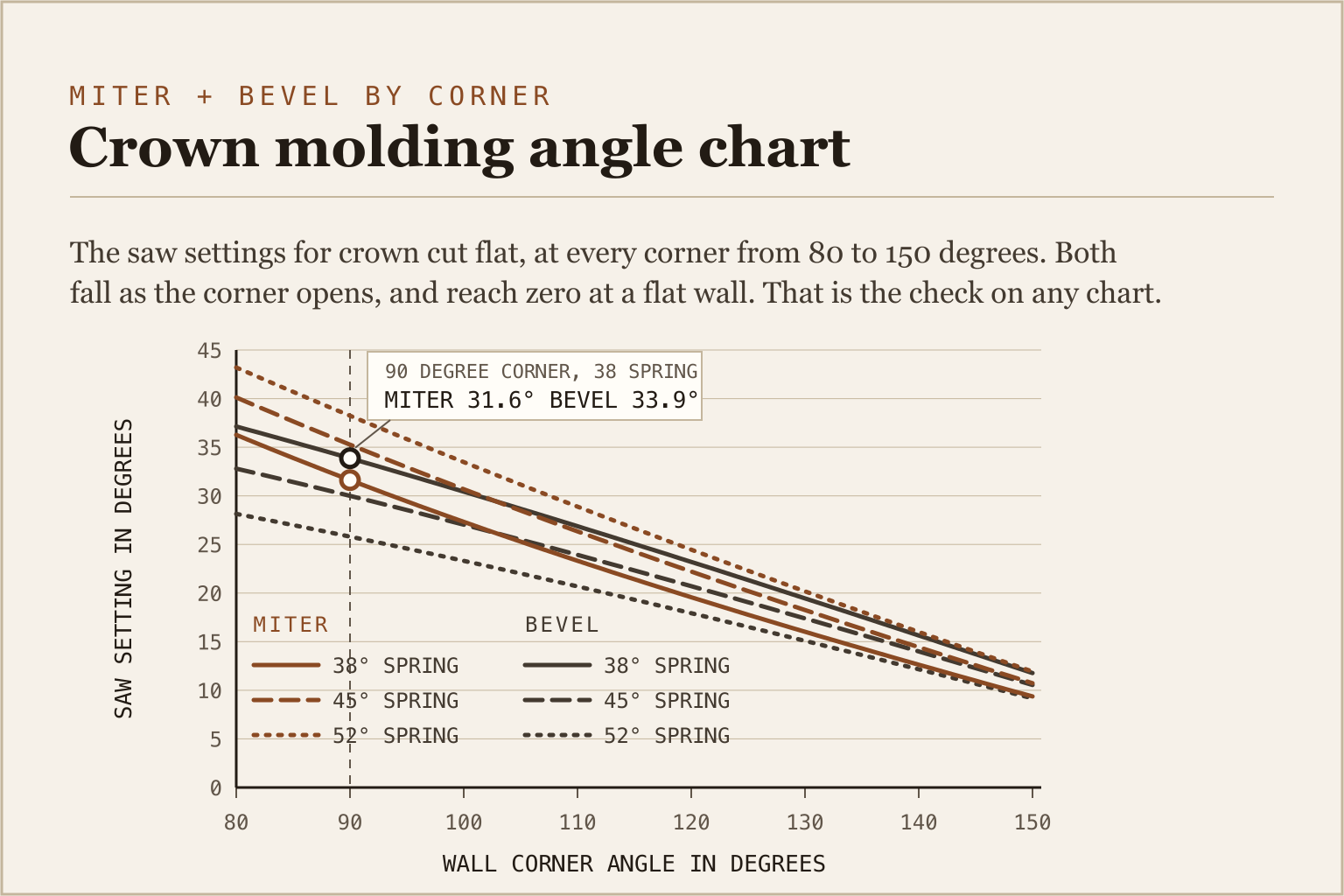
Two numbers decide every crown cut. The angle your two walls actually make, and the spring angle of the molding. This chart pairs them so you can stop doing trigonometry at the saw. For the common case, a square 90 degree corner and 38 degree spring crown laid flat on the table, it is a 31.6 degree miter and a 33.9 degree bevel. Those two figures are printed on the detent plates of a lot of miter saws for exactly that reason. Every other row on the chart is what happens when your corner is not square, which is most of them.
The chart: miter and bevel for crown cut flat
These settings assume the flat method: the molding lies face up on the saw table with its ceiling edge against the fence, and the saw does the work with a table rotation (miter) and a blade tilt (bevel) at once. If that orientation is new, read how to cut crown molding flat first, because a chart is worthless if the stock sits in the saw the wrong way.
Find your measured corner angle in the left column. Read across to your spring angle. The first figure in each pair is the miter, the second is the bevel.
| Corner | 38 spring | 45 spring | 52 spring |
|---|---|---|---|
| 80 | 36.3 / 37.1 | 40.1 / 32.8 | 43.2 / 28.1 |
| 85 | 33.9 / 35.5 | 37.7 / 31.4 | 40.7 / 27.0 |
| 88 | 32.5 / 34.5 | 36.2 / 30.6 | 39.2 / 26.3 |
| 90 | 31.6 / 33.9 | 35.3 / 30.0 | 38.2 / 25.8 |
| 92 | 30.7 / 33.2 | 34.3 / 29.4 | 37.3 / 25.3 |
| 95 | 29.4 / 32.2 | 32.9 / 28.5 | 35.8 / 24.6 |
| 100 | 27.3 / 30.4 | 30.7 / 27.0 | 33.5 / 23.3 |
| 105 | 25.3 / 28.7 | 28.5 / 25.5 | 31.2 / 22.0 |
| 110 | 23.3 / 26.9 | 26.3 / 23.9 | 28.9 / 20.7 |
| 120 | 19.6 / 23.2 | 22.2 / 20.7 | 24.5 / 17.9 |
| 135 | 14.3 / 17.6 | 16.3 / 15.7 | 18.1 / 13.6 |
| 150 | 9.4 / 11.8 | 10.7 / 10.5 | 11.9 / 9.2 |
Every pair is the same for an inside corner and an outside corner. What changes between the two is the direction you swing the table and which side of the blade you keep, and that is covered in inside vs outside corners.
The 135 row is the bay window row. Bays are usually built to a 135 degree wall angle, so a 38 degree crown running around one wants a 14.3 degree miter and a 17.6 degree bevel, nowhere near the 45 degrees people reach for. Measure your own bay anyway. Framers miss it more often than you would think.
Sim Ayers publishes the same table on sbebuilders.com and gives 38 degree spring crown at 31.62 miter and 33.86 bevel for a 90 degree corner, 27.32 and 30.43 at 100, 23.32 and 26.87 at 110, 19.57 and 23.20 at 120, and 14.31 and 17.55 at 135. Every figure in the chart above matches his to a hundredth of a degree.
Source: Sim Ayers, Crown Molding Miter Angle and Bevel Angle Settings (sbebuilders.com).What angle do you cut crown molding for a 90 degree corner?
A square corner with 38 degree spring crown cut flat takes a 31.6 degree miter and a 33.9 degree bevel. Swap the profile and both move: 45 degree spring wants 35.3 and 30.0, and 52 degree spring wants 38.2 and 25.8. The spring angle alone spreads the miter by 6.6 degrees, so knowing your profile comes before knowing your corner.
If you cannot tell which of the three you have, the number is often stamped on the molding or the box. Failing that, crown molding spring angle walks through measuring it against a framing square.
What if my corner is not exactly 90 degrees?
It probably is not. Drywall mud, framing tolerance, and forty years of settling all push a corner off square, and two or three degrees is invisible to your eye and obvious at the joint. Measure with a digital angle finder or a sliding bevel, then read the row that matches. Here is 38 degree spring crown, one degree at a time.
| Corner | Miter | Bevel |
|---|---|---|
| 85 | 33.9 | 35.5 |
| 86 | 33.4 | 35.2 |
| 87 | 33.0 | 34.9 |
| 88 | 32.5 | 34.5 |
| 89 | 32.1 | 34.2 |
| 90 | 31.6 | 33.9 |
| 91 | 31.2 | 33.5 |
| 92 | 30.7 | 33.2 |
| 93 | 30.3 | 32.8 |
| 94 | 29.9 | 32.5 |
| 95 | 29.4 | 32.2 |
The pattern is steady across that band. One degree of corner moves the miter about 0.45 degrees and the bevel about 0.33 degrees. The makers of the True Angle tool at compoundmiter.com publish 30.3 degrees of miter for a 93 degree corner on 38 crown, which is the same figure this chart gives.
What a small misread actually costs
Call a 93 degree corner square and your miter is 1.3 degrees off. Both pieces get cut with the same error, so the joint opens by twice that. Work it through on a 3-5/8 inch crown, which meets the saw with a cut face a little over 4-1/4 inches long, and you get close to 3/16 inch of daylight at the wide end. That is a caulk-and-hope joint. Three-sixteenths is also about the point where a homeowner stops seeing trim and starts seeing the gap.
How to sanity check any angle chart
One rule catches a bad chart or a broken calculator in about four seconds. As the corner opens toward a flat wall, both settings have to fall toward zero, because a wall with no corner in it takes a square cut. Look down the chart above: the miter runs 31.6 at a square corner, 19.6 at 120 degrees, 9.4 at 150. The bevel does the same thing.
If a chart or a calculator hands you a bigger miter for a wider corner, it has the corner angle inverted somewhere, and the number it gave you for the bay window is the number for a very sharp corner instead. Check the 135 degree row before you trust any source. It should read in the teens for 38 crown, not the fifties.
Does the chart change if I cut the crown nested?
Yes, and it gets simpler. Nested means standing the molding against the fence at the angle it will hang, upside down, so the saw makes one plain cut. The bevel stays at zero and the miter is half the turn: subtract your corner from 180 and halve it. That is 45 degrees for a square corner and 22.5 for a 135 degree bay, the two settings Rockler names for the method.
The catch is that nesting depends on you holding the same spring angle for every single cut, and wide crown will not sit against a standard fence at all. The author of Fine Homebuilding's crown molding fundamentals switches to cutting flat once the molding passes 5-1/2 inches. The chart on this page is the flat one, because flat works on any saw and any width.
The formulas behind the chart
Both settings come out of two lines of trigonometry, with C for the corner angle and S for the spring angle:
- miter = arctan( sin S / tan (C / 2) )
- bevel = arcsin( cos S x cos (C / 2) )
Run the standard case by hand and you can check the whole chart. sin 38 is 0.6157 and tan 45 is 1, so the miter is arctan 0.6157, which is 31.62 degrees. cos 38 is 0.7880 and cos 45 is 0.7071, so the bevel is arcsin 0.5572, which is 33.86 degrees.
For a corner that lands between the rows, or a profile that is not one of the three common ones, put your own two numbers into the crown molding angle calculator instead of interpolating. And if you have not measured the corner yet, crown molding for odd corners covers how to get a trustworthy reading out of a corner full of drywall mud.
Sources
- Sim Ayers, "Crown Molding Miter Angle and Bevel Angle Settings": flat and on-edge tables by corner and spring angle (sbebuilders.com).
- Family Handyman, "The secret numbers for cutting crown flat": 31.6 miter and 33.9 bevel, and the saw detents cut for them (familyhandyman.com).
- Rockler, "Crown Molding Cutting Tips": the nested method at 45 and 22-1/2 degrees with the blade square to the bed (rockler.com).
- compoundmiter.com, True Angle crown molding FAQ: measuring every corner, and 30.3 degrees of miter on a 93 degree corner (compoundmiter.com).
- Fine Homebuilding, "Crown-Molding Fundamentals": bevel boards, digital angle finders that read to a tenth of a degree, and cutting flat above 5-1/2 inches (finehomebuilding.com).
Preguntas frecuentes
What is the crown molding angle for a 90 degree corner?
Cut flat on the saw table, 38 degree spring crown takes a 31.6 degree miter and a 33.9 degree bevel at a square corner. A 45 degree spring profile takes 35.3 and 30.0, and a 52 degree profile takes 38.2 and 25.8. The corner angle and the spring angle both have to be right, because each one moves both settings.
Why is the miter not just 45 degrees?
A 45 degree miter only works when the molding lies flat in one plane, like a picture frame. Crown hangs tilted between the wall and the ceiling, so the cut has to travel through a leaning board. That takes a miter and a bevel together. The one time you set a plain 45 is when the crown is nested against the fence at its spring angle and the blade stays vertical.
What miter and bevel do I use on a 135 degree bay window?
For 38 degree spring crown at a true 135 degree corner, set a 14.3 degree miter and a 17.6 degree bevel. A 45 degree profile takes 16.3 and 15.7, and a 52 degree profile takes 18.1 and 13.6. Check the bay with an angle finder before you cut, because framed bays often come in a degree or two off 135.
Do inside and outside corners use different numbers?
No. For any given corner angle and spring angle the miter and bevel are the same size for both. What flips is which way you rotate the saw table and which side of the cut you keep. Mark the room-facing side of every piece before it goes near the blade, and dry-fit the joint before a nail goes in.
Can I print this chart and keep it at the saw?
Yes. Print the page and the tables come with it. Most people only need the 38 spring column plus the one-degree table, so a lot of trim carpenters tape those to the saw stand and measure each corner as they get to it rather than assuming any of them are square.